How to Make Espresso at Home (With or Without a Machine)

Most of us have a moment with espresso at home where the shot comes out either thin and sour or dark and harsh, and we wonder whether the café knows some secret we don't. They mostly know three numbers and own a good grinder. A perfectly-frothed cappuccino is my favorite drink beyond the basics, which means I've pulled more shots than I can count, and the truth is that espresso at home is less about the machine than about the grind, the dose, and a fresh bag. Here's how to make a good shot with a machine, how to get close without one, and the beans that make it worth the trouble.
The short answer
Most of us think espresso needs a pricey machine, but a good shot is mostly a fine grind, the right ratio, and fresh beans, and I'll walk you through it.
- What it is: concentrated coffee forced through fine grounds under pressure, about 18 g in, 36 g out, in 25–30 seconds.
- No machine? a moka pot or AeroPress gets you a strong, espresso-like shot.
- The grind is king: fine and even, which means a burr grinder, not a blade.
- The bean decides it: fresh, espresso-roasted coffee is the line between syrupy and sour.
What is espresso, exactly?
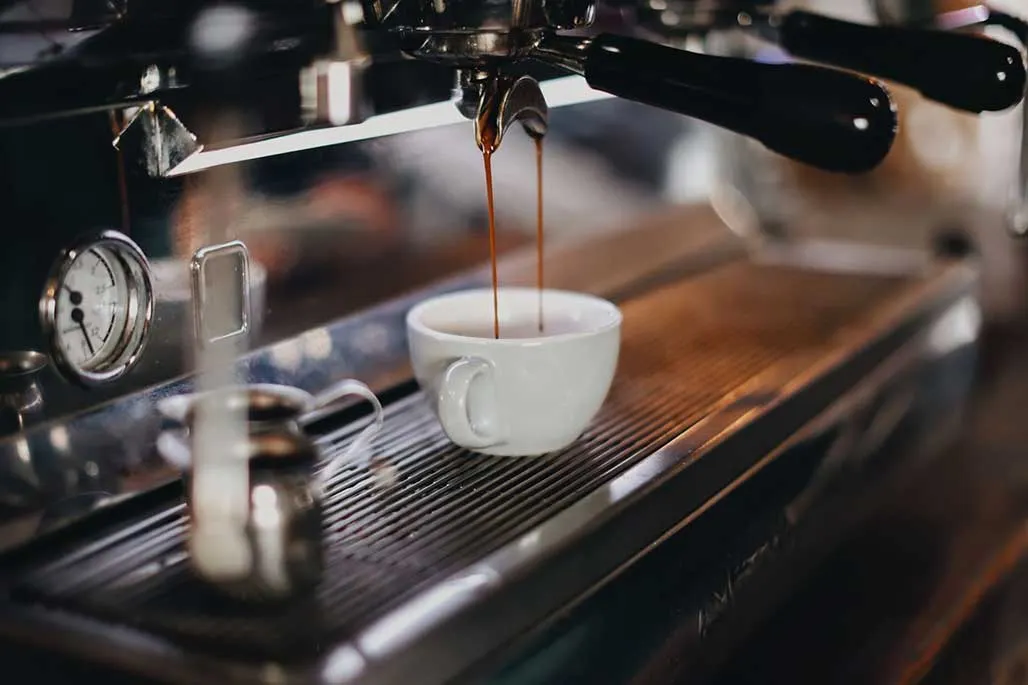
Espresso isn't a bean or a roast; it's a method. You force hot water through a compact puck of finely-ground coffee under roughly 9 bars of pressure, and what comes out is a small, intense, syrupy shot capped with crema (the caramel-colored foam that floats on a fresh pull). Drip coffee and espresso both pass water through grounds, but pressure is what changes everything: it pulls more out of the coffee, faster, into a fraction of the liquid. That's why a 1 oz shot tastes so much bigger than the cup it came in.
How much caffeine is in espresso?
Less than the intensity suggests. A single shot runs about 63 mg of caffeine and a double about 125 mg, which is actually a touch less than a full mug of drip coffee. Espresso just delivers it in a tiny, concentrated package, so it tastes (and hits) like more. If you want the full breakdown by drink, here's how much caffeine is in your cup.
What you'll need
- A pressure brewer. A home espresso machine is the classic tool. No machine? A moka pot or AeroPress (more on both below) get you most of the way there.
- A good grinder. This is the part people skip and shouldn't. Espresso lives or dies on a fine, even grind, which a blade grinder simply can't do. Here's why a burr grinder beats a blade.
- A scale. Espresso is a weighing game: grams in, grams out. A small scale makes every shot repeatable.
- Fresh, espresso-roasted beans. Espresso magnifies everything, good and bad, so freshness matters more here than anywhere. Start with coffees for espresso.
How to make espresso with a machine
Here's the core recipe. The numbers are the modern specialty default, and they work on almost any machine.
- Dose. Weigh about 18 g of finely-ground coffee into your portafilter basket.
- Distribute and tamp. Level the grounds with a finger or a tool, then tamp straight down with firm, even pressure. A flat, level puck keeps the water from racing through one spot.
- Pull the shot. Lock the portafilter in, put your cup on the scale, and start the pump. You're aiming for about 36 g of espresso out (a 1:2 ratio) in 25 to 30 seconds.
- Read it. A shot that gushes out fast and tastes sour wants a finer grind. A shot that drips slowly and tastes bitter wants a coarser one. Change one thing and pull again.
That last step is the whole craft, and it deserves more than a line. When you open a fresh bag, our 20-minute dial-in guide walks through the exact shot-by-shot protocol. And if you're still choosing a machine, the honest home espresso machine guide lays out what each price tier actually buys you.
How to make espresso without a machine
You can't make true espresso without pressure, but you can make a concentrated, espresso-like shot that works in a latte, a cappuccino, or an americano.
- Moka pot. The stovetop classic. It uses steam pressure to push water up through a bed of grounds, for a strong, rich shot with real body. Our guide to using a moka pot covers the grind and the heat trick that keeps it from turning bitter.
- AeroPress. Press a fine grind through with firm hand pressure and you get a concentrated, low-bitterness shot. No crema, but plenty of flavor, and it travels anywhere.
Neither makes a textbook shot with thick crema, but for milk drinks and americanos, most people can't tell the difference once the milk or water goes in. Between the two, reach for a moka pot if you want body and a stovetop ritual, and an AeroPress if you want fast, forgiving, and easy to clean.
Do you need an espresso machine?
If espresso is your daily drink and you want true crema and café texture, a machine earns its counter space, and the honest home espresso machine guide breaks down what each price tier actually buys. But if you mostly want espresso for the occasional latte or americano, start with a moka pot or AeroPress and put your money into a good grinder. I'd back the grinder over the machine every time: a modest machine with a great grinder beats a great machine with a bad one, because espresso rewards a consistent grind above all else.
Dialing it in
Espresso is the most sensitive way to brew, which is the fun of it and the frustration. The two dials you'll reach for most:
- Grind controls how fast the water flows. Finer slows it down (more extraction); coarser speeds it up (less). This is your main lever.
- Ratio and time fine-tune the rest. Stay near 1:2 and 25–30 seconds, and adjust grind until the shot lands in that window and tastes balanced.
Here's the quick diagnostic:
| Shot | Likely cause | Fix |
|---|---|---|
| Sour, gushes out fast | Under-extracted (grind too coarse) | Grind finer |
| Bitter, drips slowly | Over-extracted (grind too fine) | Grind coarser |
| Thin, little crema | Stale beans, or grind too coarse | Fresh beans, grind finer |
| Hollow or weak | Dose too low | Add a gram or two |
Change one variable at a time and taste between each. For the full shot-by-shot routine, our dial-in guide is the deep dive.
The beans make the shot
Here's the part no machine can fix. Espresso concentrates a coffee, so it amplifies whatever is in the bag: a sweet, chocolaty espresso roast becomes a syrupy, caramel shot, while a stale or under-roasted bag becomes a sharp, sour one. Two directions worth trying:
- A classic espresso roast (often a medium-roast or a touch darker) for that familiar cocoa-and-caramel shot that shines on its own and under milk.
- A bright single-origin if you want a modern, fruit-forward shot that tastes like espresso never used to.
Above all, buy fresh and grind right before you pull. Espresso fades fastest of any brew, so a rotation of freshly roasted bags beats one big stale tub every time. If you'd like that handled, you can build a coffee subscription around your taste, and we'll send fresh-roasted coffee from dozens of independent US roasters, so there's always a great shot in the bag.
Frequently asked questions
What is espresso? Concentrated coffee forced through fine grounds under pressure: a syrupy 1–2 oz shot with crema. It's a method, not a bean.
Can I make espresso without a machine? Not true espresso, but a moka pot or AeroPress gets you a strong, espresso-like shot that works great in milk drinks.
What grind do I need? Fine and even, finer than table salt. A burr grinder is the upgrade that matters most.
What's the right ratio? About 1:2: 18 g in, 36 g out, in 25–30 seconds.
How much caffeine is in a shot? Roughly 63 mg single, 125 mg double, less than a full mug of drip despite the intensity.
Why is my shot sour or bitter? Sour is under-extracted (grind finer); bitter is over-extracted (grind coarser). Adjust one thing at a time.
One last shot
A good espresso at home isn't about the most expensive machine on the counter. It's a fine, even grind, a steady 1:2 pull, and a fresh bag worth pulling. Get those three right, taste as you go, and adjust one dial at a time. The café's secret was never a secret. It was a grinder and good beans.
We want to help you make better coffee at home. Our recommendations are our own, and never sponsored. If you see something you love and buy it through our links, we may receive an affiliate commission (thanks for that!).