How to Dial In a New Bag of Espresso in Under 20 Minutes
 Maryna Gray
• June 25, 2026 — last updated July 21, 2026
Maryna Gray
• June 25, 2026 — last updated July 21, 2026
Most of us have stood in front of an espresso machine at 7 a.m., a fresh bag of beans torn open beside the grinder, and watched the first shot run through in nine seconds and taste like grapefruit juice. The clock said the shot was wrong; the cup confirmed it. So you grind finer, run it again, and it stalls at 45 seconds and tastes like burnt walnuts. By the third pull, half the bag is gone and the espresso is no closer to what you remember pulling last week.
Every new bag of espresso needs a dial-in. Roast date, bean density, ambient humidity, and even grinder burr temperature shift between bags, per Happily Coffee's dial-in walkthrough. Same coffee, different week, different recipe. Most dial-in guides hand you a list of variables and wish you well. This one hands you a stopwatch. Four shots, five minutes each, in a fixed order: lock the dose, grind for time, taste, then make one adjustment per shot. Three shots gets most people there. Four is the worst case for a familiar grinder, and the math still lands you under twenty minutes.
Pour-over is my daily method, but a perfectly-frothed cappuccino is my favorite drink beyond the basics, which means I've dialed in enough espresso to know the rhythm. The variables aren't difficult. The order is. Let me walk you through the protocol I'd run on a Tuesday morning, kitchen scale on the counter and timer in my hand.
The short answer
Most of us have wasted half a bag chasing a balanced shot, but a good espresso dial-in is mostly four shots, twenty minutes, and one adjustment at a time, and I'll walk you through it.
- The baseline: 18 grams in, 36 grams out, in 25 to 30 seconds at about 200°F. That's the modern specialty default, anchored in Hoffmann's published espresso recipe.
- The protocol: lock the dose first, grind to land the time, taste, then make one small adjustment per shot. Three shots usually does it. Four if the grinder is unfamiliar.
- The decision tree: sour shot, grind finer. Bitter shot, grind coarser. Sour and bitter in the same cup, fix puck prep first.
- The prerequisite: the coffee should be 5 to 10 days off roast. Outside that window, the dial-in is harder for reasons that aren't your fault.
Before you start: the three prerequisites
A fresh bag, 5 to 10 days off roast. This is the sweet spot, per Clive Coffee's all-inclusive dial-in guide. Too fresh, under about 5 days, and the puck off-gasses carbon dioxide so vigorously that the shot channels and runs uneven. Too old, past about 3 weeks, and the flavor flattens and the dial-in still works but the ceiling drops. Check the roast date stamped on the bag. The deeper take on what "fresh" means and how to make sure you're getting it is its own piece — why fresh-roasted coffee tastes different.
A burr grinder you can adjust in small steps. Stepless is ideal; you can move a hair finer. Stepped grinders (the Sette 270, the Eureka Specialita) still work, just expect to move a notch at a time. Pre-ground espresso defeats the protocol. By the time you've opened the bag and pulled three shots, the grind has staled past usable.
A kitchen scale and a timer. Weigh the dose in. Weigh the shot out. The phone timer is fine. Most home machines run at 200°F (about 93.5°C) by default, per EspressoAF's beginner guide, which is a sensible starting point. Leave the temperature alone for the first dial-in. It's the last variable, not the first.
One note on baskets: this protocol assumes a standard 58 millimeter unpressurized double basket. Lever machines, single baskets, and pressurized baskets play by different rules. The order of operations still holds, but the numbers shift.
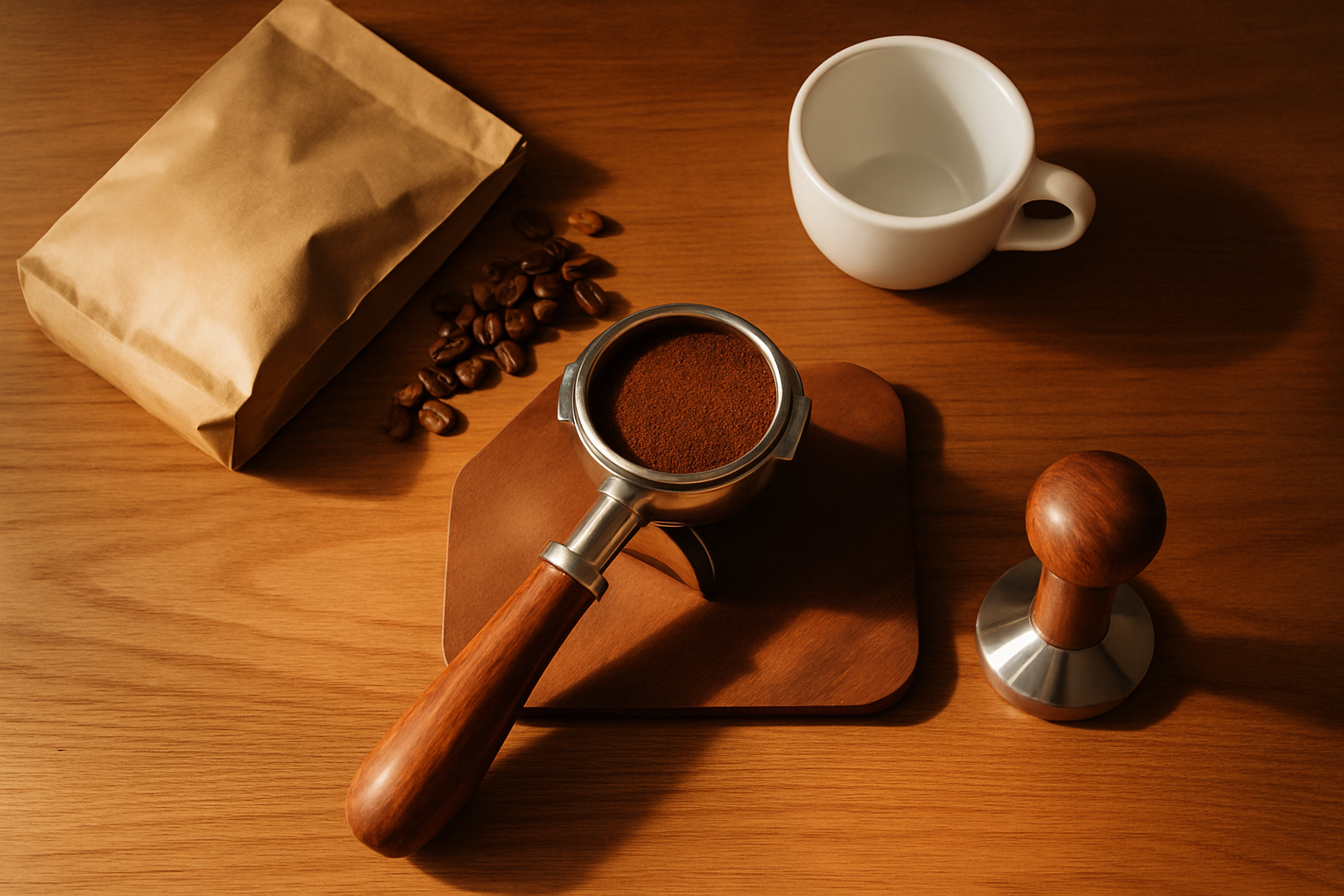
The protocol: four shots in twenty minutes
The order of operations matters. Dose first, then grind for time, then taste, then adjust grind. Ratio and temperature come last. Per Perfect Daily Grind's framework and Clive's dose-yield-time order, this is the consensus across professional sources.
Lock the dose. Lock the yield.
Set your dose at 18 grams in. Set your target yield at 36 grams out. That's the 1:2 ratio, the modern specialty default in basically every cafe in the country. Don't touch these numbers for the first three shots. The dose is the constant against which everything else moves. (Grind size is the other variable doing the heavy lifting. For grind across every brew method, the grind size cheat sheet is its own piece.)
Shot one: the diagnostic pull (about 5 minutes)
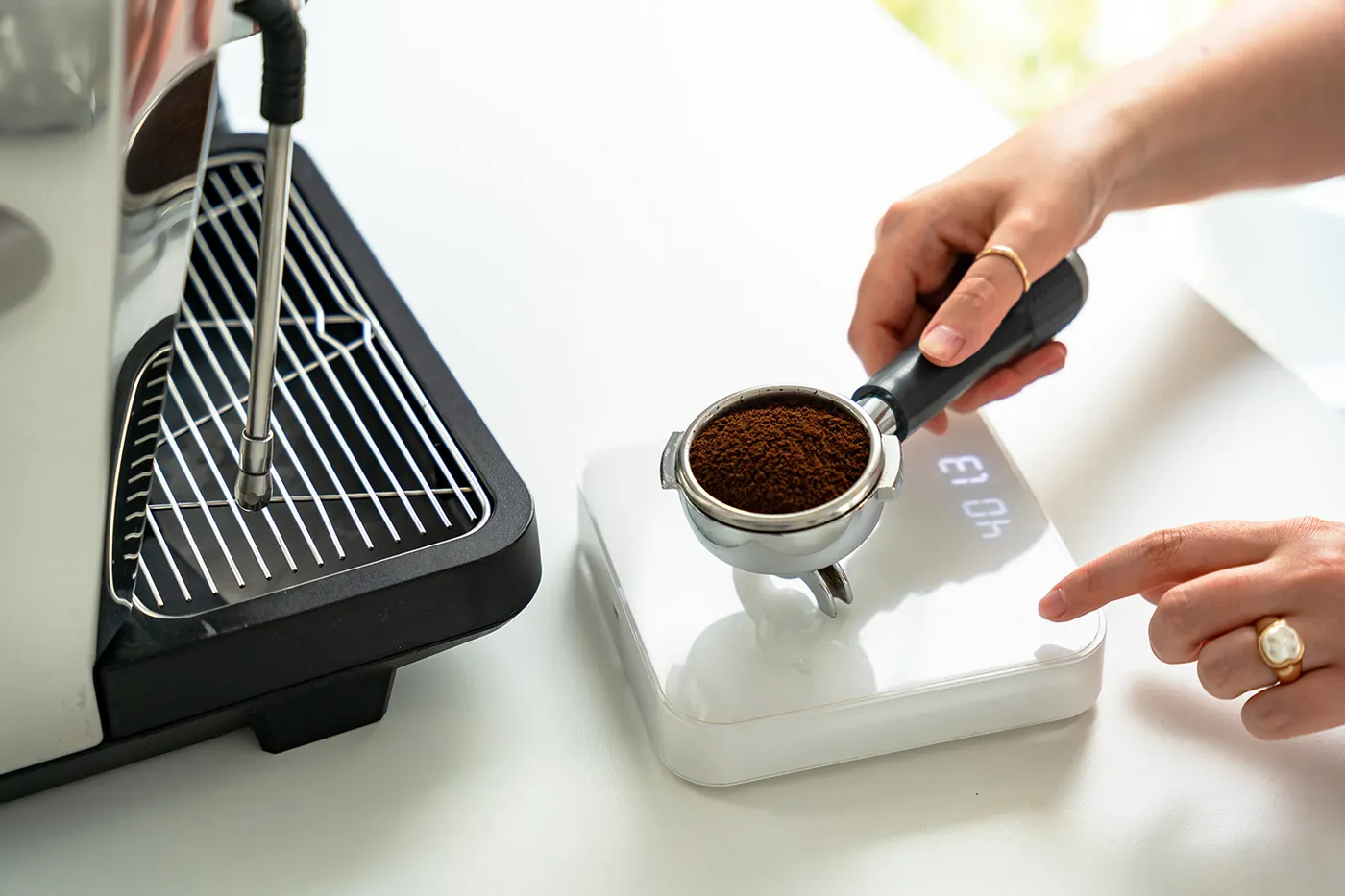
Set the grind where you'd usually start for espresso, or one notch finer than where the grinder lived for the last bag, since new bags tend to want a hair finer. Weigh 18 grams in. Distribute the grounds. WDT them if you have a WDT tool; a stir-stick or a thin needle works in a pinch, and that one motion alone breaks up the clumps that cause channeling. Level tamp. Start the shot and the timer at the same moment. Pull to 36 grams. Stop.
From our coffee sommelier
Maryna's weekly picks
“I taste thousands of coffees a year — I’ll only send you the few worth brewing.”
Something went wrong — please try again.
Free · Weekly · Unsubscribe anytime
Now read the time. Don't taste yet. Under 20 seconds? Grind is too coarse. Over 35? Too fine. Right in the 25 to 30 second window? You're already close, and shot two is the verification.
Shot two: adjust the grind, not the dose (about 5 minutes)
Move the grinder one notch finer if shot one ran fast, one notch coarser if it ran slow. One change at a time. Re-weigh 18 grams in. Same puck prep. Same target, 36 grams out. Pull. Time it.
If you've landed inside the 25 to 30 second window, taste it. If you're still outside, adjust the grind one more notch in the same direction and pull shot three. This is also where most newcomers want to change too many things at once. Resist that. Adjust one variable per shot, or the protocol breaks.
Shot three: taste-led adjustment (about 5 minutes)
Once you're in the time window, taste becomes the deciding variable.
If the shot is sour, grind one notch finer. Sour means under-extracted; water moved through the puck too fast even though the clock looked right. If the shot is bitter, grind one notch coarser. Bitter means over-extracted; water spent too long pulling soluble compounds. If the shot is sour and bitter in the same sip, fix puck prep, not the grind. That combination almost always means channeling, water finding a fast path through the puck and leaving the rest under-extracted, per Almenhaz's troubleshooting deep-dive and the long-running r/espresso consensus. Improve distribution: WDT, level the bed, level tamp. Don't touch the grind until the puck is even. (Clive's dialing-in by taste is the cleanest version of this decision tree.)
For the visual side of what an even puck and clean shot look like, our piece on what crema in espresso actually tells you is the companion read. If a four-shot protocol still isn't getting you balanced (the cup is sour AND bitter and the prep isn't fixing it), the diagnostic pair to this protocol is our deeper read on why your espresso tastes sour, bitter, or watery and the single fix for each.
Shot four: verify (about 5 minutes)
Same numbers, same prep, one more pull to confirm the change held. If it tastes balanced (sweet, syrupy, chocolate or fruit at the back, clean finish, no harsh edge), you're done. Save the recipe somewhere. A note on your phone is fine: dose, yield, grind setting, time. Tomorrow's first shot of the same bag starts from this number, not from scratch. Done.
When taste says one thing and the timer says another
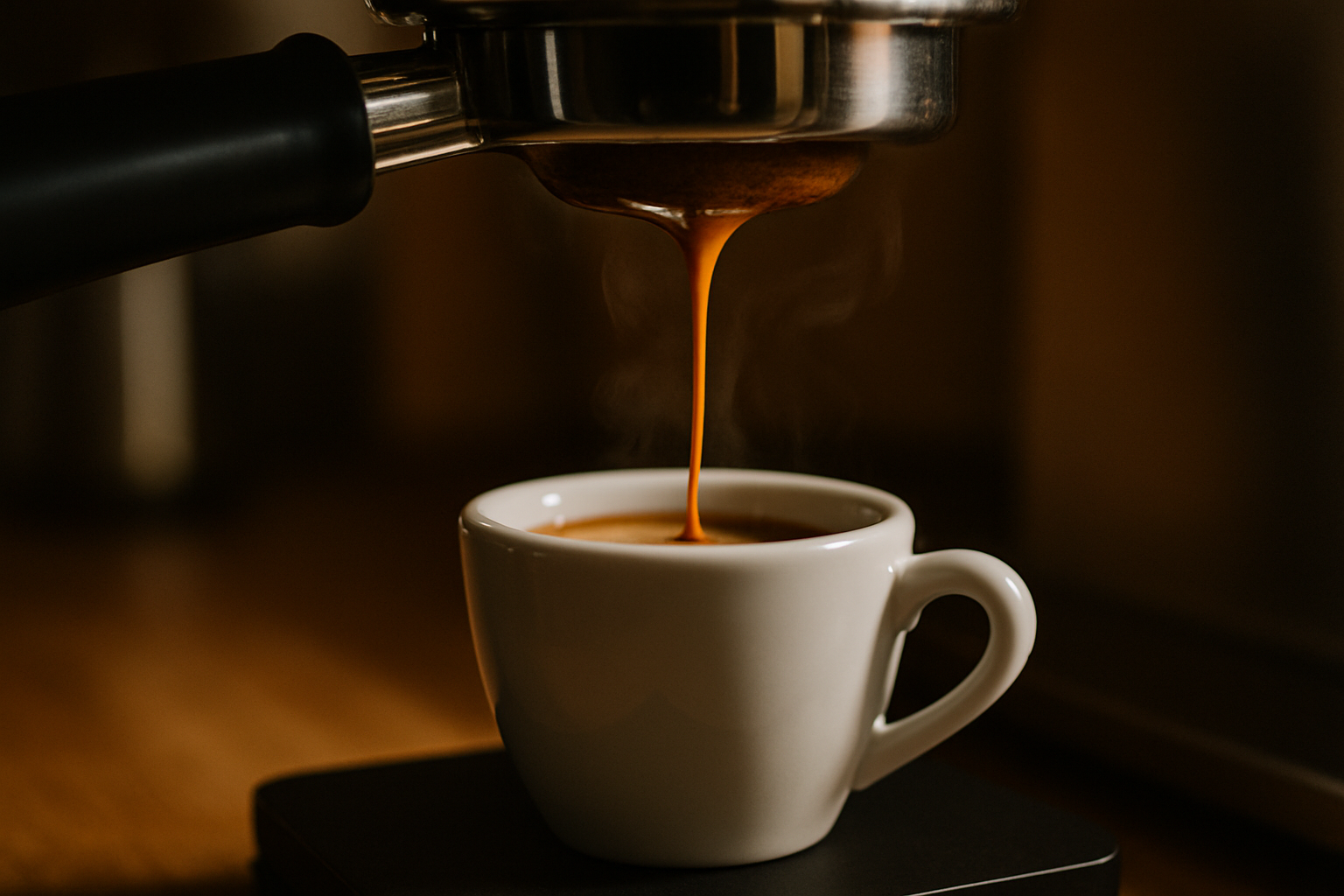
The 25 to 30 second window is a target, not a verdict. Once you're inside it, the taste is what you're chasing. Lance Hedrick calls extraction time "a flow meter, not a goal" in his espresso dial-in walkthrough, meaning that time tells you whether water is moving through the puck at the right rate, not whether the cup tastes the way you want it to. Two shots that both land in 28 seconds can taste meaningfully different. The clock tells you part of the story. Taste tells you the rest.
The professional caveat: cafes work in a wider 22 to 40 second window, with 25 to 32 seconds as the typical sweet spot, per Perfect Daily Grind. Lighter roasts often land at the long end of that range, and a Geisha-style washed light roast that lands at 38 seconds and tastes like jasmine is doing exactly what it should. The timer is a soft fence, not a hard one.
When I taste a shot, I pull it on the palate the way I taste a pour-over: first the front (where acidity sits), then the middle (where the body lives), then the finish (which either goes clean and chocolatey or harsh and dry). On a syrupy 1:2 from a medium roast, the middle should feel like cocoa or caramel and the finish should fade out, not crash. If the front is bright and citric-tart but the back is dry and grippy, that's the sour-and-bitter signature of channeling, even if the clock said 28 seconds. The cup is the final dial.
If four shots and nothing is working, try a turbo shot. Coarser grind, shorter time (around 12 to 15 seconds), longer ratio (1:2.5 or 1:3), per EspressoAF. It's much more forgiving on puck prep than a classic 1:2 in 30 seconds. Sometimes a stubborn bag dials in twice as fast as a turbo than as a traditional shot. Worth pocketing as plan B.
When the bean is the variable: light, medium, dark
A 1:2 in 28 seconds is the universal baseline, but the bean shifts the picture. Light roasts are denser and less soluble. Dark roasts are softer and more soluble. The protocol still applies, you just shift the target.
For light roasts (think pour-over-style beans you're brewing as espresso), push the grind finer, the water hotter (toward 95 to 96°C, about 203 to 205°F), and the ratio longer. 1:2.5 or 1:3 is the range Papel Espresso recommends in their roast-level dial-in adjustments. Time can land outside 30 seconds. Some light roasts open up at 35 or 40. Trust the taste.
For mediums (the largest share of the specialty espresso catalog), default 1:2 in 25 to 30 seconds at 200°F. This is the easiest place to start a dial-in, and the protocol above is written around it.
For dark roasts (traditional Italian style, the kind of espresso that goes into a cappuccino), coarser grind, cooler water (90 to 92°C, about 195 to 198°F), shorter ratio (1:1.5 to 1:2) across 22 to 28 seconds. Dark roasts get bitter quickly past 1:2.
In the Bean Box catalog, roughly four in ten of the coffees for espresso sit at a medium roast, the forgiving place to point this protocol first.
What to dial in next
Once the protocol is in your hands, the question becomes what to pull through it. A good rule: rotate the roast level you point it at, especially if you usually drink one kind of espresso. The dial-in is faster on familiar territory; you learn the most on territory you haven't worked yet. A washed light roast at 1:2.5 in 35 seconds opens up the bright fruit side of the bean. A dark blend at 1:1.8 in 25 seconds gives you the syrupy cappuccino base. The same protocol gets you both. You just shift the targets.
Bean Box carries roughly 100 coffees for espresso across dozens of independent partner roasters. About four in ten are medium-roast coffees, the most forgiving starting point for a fresh dial-in, and a smaller bench of light-roast coffees when you're ready to push the protocol to its harder case. If the 5-to-10-day freshness window is the part that worries you, that's exactly what a coffee subscription you can build around your espresso routine was built for. Set the cadence to the pace you actually pull shots, pick the roast profile you want, and the next bag shows up at the freshness window the protocol depends on.
The cup I'm chasing on the fourth pull of a new bag is small and obvious. A single mouse-tail. Brown crema, glossy, not bubbly. The first sip warm and sweet, the middle thick like cocoa, the finish clean with a little bit of fruit at the back. Twenty minutes of work for a recipe that runs for the next two weeks. That's the protocol doing what it was made to do.
We want to help you make better coffee at home. Our recommendations are our own, and never sponsored. If you see something you love and buy it through our links, we may receive an affiliate commission (thanks for that!).
From our coffee sommelier
Maryna's weekly picks
“I taste thousands of coffees a year — I’ll only send you the few worth brewing.”
Something went wrong — please try again.
Free · Weekly · Unsubscribe anytime