How to Taste Coffee Like a Pro
 Maryna Gray
• April 07, 2021 — last updated June 24, 2026
Maryna Gray
• April 07, 2021 — last updated June 24, 2026
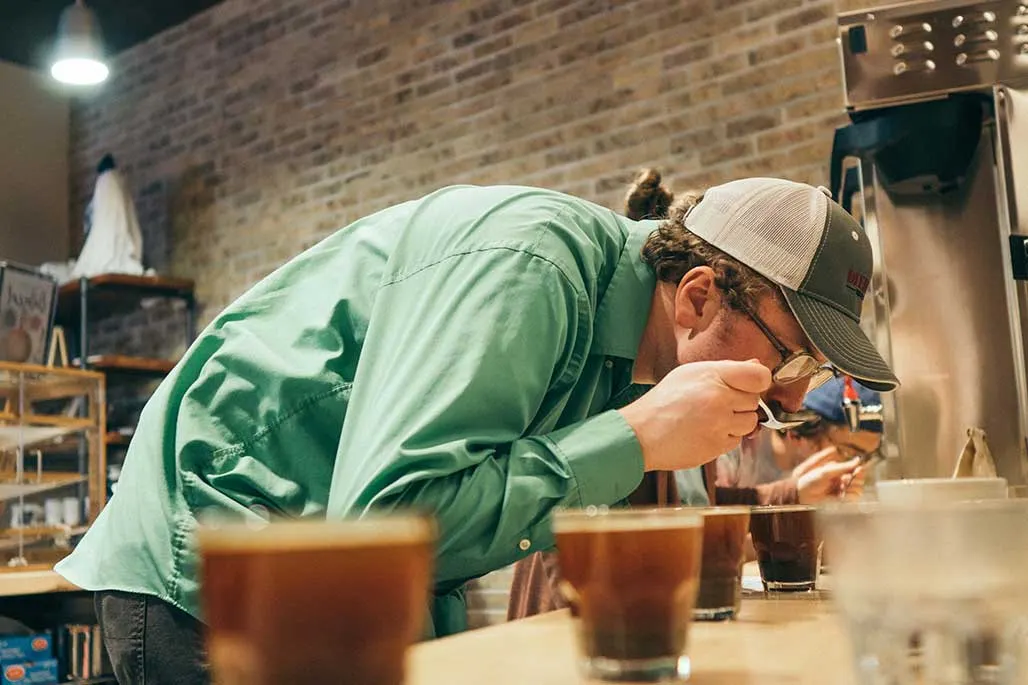
People ask me how to "properly" taste a rare, expensive, special coffee, and my answer is always the same: exactly the way you'd taste any coffee you love. Tasting isn't a license you earn. It's a habit of paying attention, and it's one of the most rewarding things you can bring to your morning. Here's how I'd teach you to open up your palate and actually taste what's in the cup.
1. Don't stress about brew method
Pros taste coffee through a strict ritual called cupping, and unless you're training to grade or roast beans, you can happily skip it. It's a lot of overhead, and honestly it's not a pleasant way to enjoy a cup. Brew however you love. If you want the cleanest window into a coffee's flavor, a pour over like the Chemex is hard to beat, but an AeroPress or French press is perfectly good too. Brew method is secondary to the things that really move the cup: clean water, fresh beans, and a consistent grind.
2. Use your nose
Most of what we call "taste" is actually smell. Flavor lives where your senses of smell and taste meet, so I want you to stop and inhale at a few key moments:
- Smell the whole beans.
- Smell again right after you grind, where the aromatics jump out.
- On a pour over, lean in and inhale the bloom, that first wetting of the grounds.
- Before your first sip, tip the cup toward your nose and breathe in.
Each one smells a little different, and together they wake up your brain for everything the coffee is about to do.
3. Taste each sip on purpose
There's roughly twice as much going on flavor-wise in coffee as in wine, but you don't need fancy vocabulary to find it. Start with a small sip, then take a bigger, slurpy one that sprays across your whole tongue (slurping aerates the coffee, it's supposed to be loud). Close your eyes and look for four things:
- Sweetness. Brown sugar, honey, caramel, molasses?
- Acidity. The bright, lively side: citrus, berry, lemon, even watermelon. Worth knowing, acidity as a flavor isn't the same as a coffee being acidic on the pH scale.
- Body. How it feels: rich and syrupy, light and tea-like, silky, watery?
- Cleanliness. What happens after you swallow. Great coffees finish neutral and clear; rougher ones linger with one harsh note, often bitter or burnt.
Can't name a specific flavor? Just sort it into a family: chocolatey, fruity, earthy, nutty, floral. The Specialty Coffee Association's Coffee Taster's Flavor Wheel is a lovely cheat sheet to nudge you. And remember, taste is personal, and it shifts over time, just like your taste in wine or beer.
4. Learn the signature of a great cup
When I'm judging whether a coffee is truly special, I look for three things:
- Layering. Do the flavors harmonize, like baker's chocolate with caramel, or clash, like a muddy earthiness with odd flashes of citrus?
- A beginning, middle, and end. The best coffees move. They open with one set of flavors and resolve into another, like a good story. A one-note coffee can be tasty, but it rarely thrills.
- What happens as it cools. This is the big one. Great coffee gets more interesting as it drops in temperature. If your cup turns bitter and sad as it cools, that's a tell. (Piping-hot coffee hides flaws, because scalding temperatures mute your palate, which is exactly why bad coffee is served blistering.)
5. Host a mini tasting
Sometimes you need a side-by-side to really see a coffee. Brew two or three roasts and taste them with friends. Our sampler boxes are made for this, but any coffees work. Try a fresh coffee next to a not-so-fresh one (you can guess how that goes), or taste a single origin beside a blend that contains it and hunt for its fingerprint. Compare notes. You'll be amazed what one person catches that another misses. You're not imagining it, I promise.
Training your palate takes a little time and a lot of delicious practice. The fastest way to start? Put a few genuinely great, different coffees in front of yourself and pay attention. A coffee plan built around what you like keeps that variety coming. Sip, savor, enjoy.
We want to help you make better coffee at home. Our recommendations are our own, and never sponsored. If you see something you love and buy it through our links, we may receive an affiliate commission (thanks for that!).