Light, Medium, Dark — Or None of the Above? Why Roast Levels Stopped Making Sense
 Maryna Gray
• May 28, 2026 — last updated July 21, 2026
Maryna Gray
• May 28, 2026 — last updated July 21, 2026
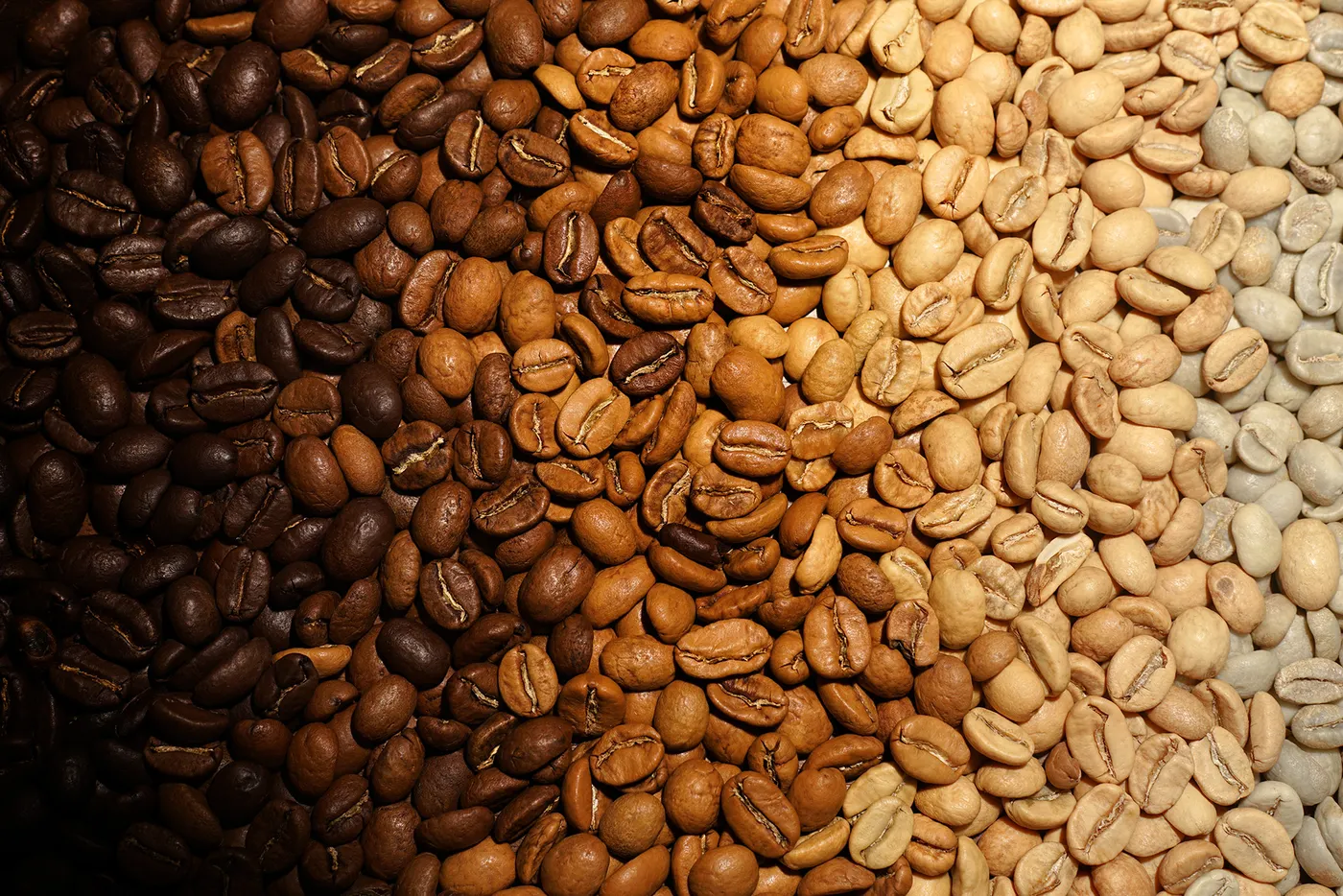
Most of us walked into the coffee aisle and learned three words — light, medium, dark — and then spent ten years quietly suspecting they didn't quite mean what we thought they meant. You picked up a bag marked "medium" at one shop, brought it home, and it tasted nothing like the "medium" you'd been drinking for a year. Or the friend who only drinks dark told you to try a light roast and you got something so fruity it could've been juice. You started to wonder whether the label on the bag was a real description, or just a vibe.
I love any roast level that brings out the bean's flavors, and I get genuinely excited when a light roast turns up banana notes. So I'm not here to pick a side. I'm here to tell you that the three labels on the bag are mostly a marketing shorthand. There's no industry standard. The Specialty Coffee Association has called visual roast identification "a terrible way to determine something as crucial as roast level" in their 25 Magazine. Even inside the 600-coffee Bean Box catalog, those three customer-facing labels collapse a 6-level internal scale into 9 different combinations. Same coffee, sometimes two different ways to describe it, because neither label alone is quite right.
Let me walk you through what those labels actually do tell you, what they don't, and the three things to look at on a bag instead.
The short answer
Most of us were taught that light, medium, and dark mean something specific, but the labels are mostly a marketing shorthand, and I'll show you what specialty roasters actually use instead.
- There's no industry standard. One roaster's medium is another's medium-dark.
- The labels track roast development, not bean color. Light = stopped near first crack. Dark = into or past second crack.
- They predict some flavors well. Light roasts are fruitier and brighter. Dark roasts are nuttier, smokier, and rounder.
- They don't predict caffeine, quality, or origin character. All three roast levels can be great. Or terrible.
Three things to read alongside the label: the roast date, the tasting notes, and the origin. Those tell you more than the bag color ever will.
What the roast label actually means
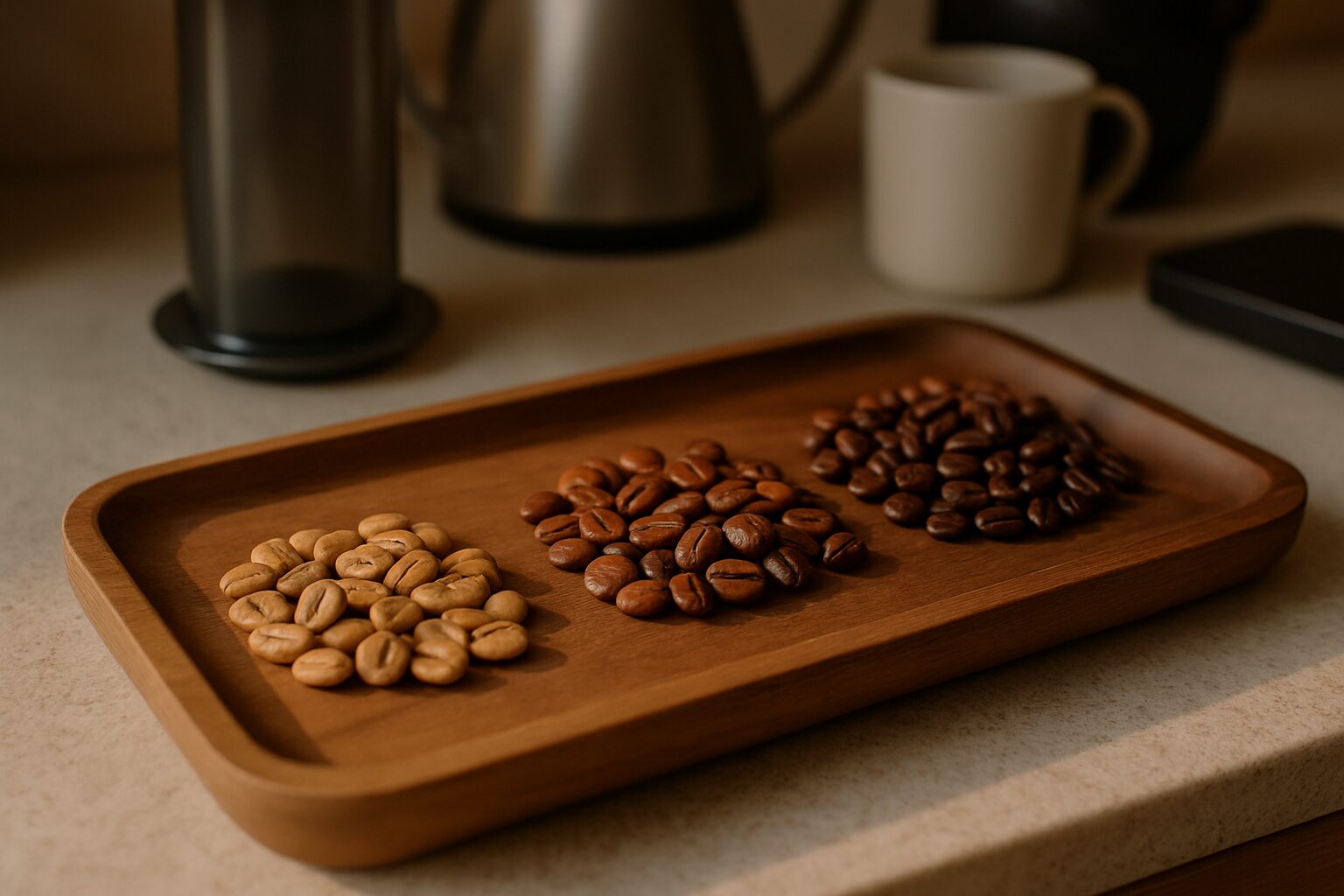
The label is describing how far the roaster pushed the beans through a heat curve, not a color you could match to a paint chip.
The most useful waypoints in that curve aren't temperatures, they're sounds. Roasting beans hit two audible milestones, and roasters use those as their stop signs. First crack happens around 196°C, roughly 395 to 405°F bean temperature, when steam pressure inside the bean cracks the structure (per mtpak.coffee on first and second crack). Second crack hits around 224°C, or 440 to 455°F, as the bean's cell walls collapse further. If you've ever stood near a roaster, the cracks really do sound like popcorn, two separate rounds with a quiet stretch in between.
Where the consumer labels sit on that curve, more or less:
- Light roasts get dropped at or shortly after first crack. Around 380 to 410°F.
- Medium roasts develop in the gap between cracks.
- Dark roasts develop into or past second crack, 440°F and up.
The numbers vary by 10 to 30°F depending on whose probe and method you trust (Peet's on light versus dark roast, The Captain's Coffee on the traditional roast spectrum). The point isn't the precise temperature. The point is which milestone the roaster decided to stop near.
Bean color is downstream of all this, and it's a lousy measurement. Color varies with the lighting in the room, the angle you tilt the bag, and whether the coffee is whole-bean or ground. The Specialty Coffee Association's 25 Magazine has the cleanest take: "Using your eyeballs is a terrible way to determine something as crucial as roast level." A 2023 SCA Roasters Guild survey of 125 specialty roasters found half of them still assess roast level by eye alone. The proper instrument exists. It's called an Agtron meter. It shines infrared light at ground coffee and outputs a number on a 0 to 130 scale, where higher is lighter. The equipment is expensive enough that most roasters don't own one, and the number rarely makes it onto the bag.
So when you read "medium roast" on a label, you're reading one roaster's best one-word description of where they stopped on the curve. Trade Coffee puts it plainly: "there is no real 'standard' that delineates one from the other." Coffee Bros. is blunter: "one roaster may describe a light roast as one depth of color, another describes it as something else entirely." Useful, but unstandardized.
Why the labels mislead
Three problems, in roughly the order they bite consumers.
From our coffee sommelier
Maryna's weekly picks
“I taste thousands of coffees a year — I’ll only send you the few worth brewing.”
Something went wrong — please try again.
Free · Weekly · Unsubscribe anytime
Problem 1: they aren't comparable across roasters. A "medium" from Stumptown isn't a "medium" from Peet's. The reasons are partly philosophical. Specialty roasters tend to lean lighter to preserve origin character. Some traditional roasters lean darker for body and consistency. The reasons are partly mechanical, too. Different roasters use different probes and reference points, and most have an in-house scale they trust over the public one. Same bag of beans, two cups, two completely different experiences.
Problem 2: the three buckets hide a much richer scale the industry uses internally. The traditional specialty-coffee spectrum has seven or more names: Cinnamon, City, City+, Full City, Full City+, Vienna, French, Italian. Some specialty roasters publish Agtron numbers. Many use seven-point internal scales. Kaldi's roast level reference maps City to light-origin beans like Ethiopia, Kenya, and Colombia, and Full City+ to chocolate-leaning origins. The three customer-facing buckets are the simplification, not the reality.
Problem 3 (this one I find funny): even inside our own catalog, the three labels can't quite contain the underlying data. Our customer-facing label is "light," "medium," or "dark." Our internal roast-level integer runs 1 to 6. Across 602 live coffees as of late May 2026, those two columns produce 9 distinct combinations, not 3. There are bags sitting at internal level 2 marked dark, and bags at level 5 marked medium. Even our own system needs both columns, because neither one alone is right.
One more myth to retire, since it lives next door to the label one. Dark roast does not have more caffeine. Neither does light, really. By weight the difference is small, and the direction depends on roast development. By volume, meaning the same scoop, light roasts measure slightly more caffeine, because dark beans are puffier and less dense, per Healthline on light versus dark roast nutrition and caffeine. The peer-reviewed Lindsey et al. study in Scientific Reports measured 134 to 165 mg of caffeine per 8oz cup across 90 samples, with caffeine declining only at very high drop temperatures (above about 400 to 420°F internal). The cup-to-cup gap is real but small, and if anything it tilts toward light roasts, not dark. The popular inversion has it BACKWARDS. The full caffeine-by-drink reference is its own piece if you want a real number for every drink.
What the labels DO still tell you
The three-bucket simplification isn't useless. It's incomplete. Some flavors line up reliably with roast level. Others don't track at all.
Here's the share of our catalog's structured tasting categories, broken down by roast profile, across the 602 live coffees we had as of late May 2026:
| Tasting category | Light | Medium | Dark |
|---|---|---|---|
| Fruity | 36% | 27% | 9% |
| Nutty | 22% | 36% | 42% |
| Sweet | 27% | 27% | 17% |
| Smoky | 0.6% | 2% | 20% |
| Floral | 5% | 2% | <1% |
| Bright & acidic | 4% | 1% | <1% |
The pattern is real. Nutty climbs steadily light → medium → dark. Smoky is almost nonexistent in light roasts and shows up loud in dark, where it's one of the most common tasting categories. Fruity peaks in medium and drops sharply in dark. Bright-and-acidic and floral are light-and-medium phenomena, mostly absent from dark.
Read that table the right way. Roast level doesn't predict every flavor, just the roast-driven ones. Smoky is created by roasting; light is the absence of it. Bright-and-acidic and floral are preserved by lighter roasting and burned off by darker roasting. Fruity and floral are origin-driven first. A natural Ethiopian is going to taste berried no matter what, but how much of that origin character survives depends on how far the roaster pushed it. Nutty and sweet sit in between, partly origin, partly roast.
That gives you a coarse flavor compass. If you reach for a bag of dark and expect bright fruit, you'll be disappointed. If you reach for a light and expect cocoa-bomb richness, you'll be confused. The labels work, but only on the categories where roast actually drives the outcome.
Three things to look at on a bag instead of the label, or alongside it:
- Roast date. Roast date matters more than roast level for taste. Most specialty coffee is best 7 to 21 days after roasting. Light roasts lose their fruit and florals fastest as they age, so a tired light roast tastes flatter than a tired dark.
- Tasting notes. If the roaster wrote them, they tend to be more accurate than the roast-level label. "Medium roast, blueberry and toffee" tells you more than "medium roast" alone.
- Origin. Where the coffee came from changes the flavor as much as how it was roasted. Ethiopian naturals taste berried at most roast levels. Sumatran beans taste earthy at any roast. The deeper take on what to check when you're shopping is its own piece.
How to use this when you're shopping
The three-bucket label is the first filter, not the last word. Match the roast to the brew you actually make at home, and you'll get a cup that tastes more like what the bag promised.
For pour-over and drip, our light-roast coffees and lighter mediums shine. The brewing method highlights clarity, and light roasts have clarity to share, the fruit, the florals, the bright top notes. Pour-over is my daily method. Single origin, mostly black, the kind of routine where I smell the bloom while the kettle settles. A clean Ethiopian washed in a V60 is the cup I keep coming back to.
For French press and immersion brews, medium roasts are the easy default, full-bodied without being heavy. The longer steep extracts more body and sweetness, and the heavier mouthfeel of an immersion brew flatters the caramel and nut notes that medium roasts tend to carry. Try our medium-roast coffees if you don't know where to start.
For espresso, the SERP consensus and the catalog data both lean medium-to-dark. The rounded flavors and heavier body hold up under nine bars of pressure, and traditional Italian espresso blends sit firmly in the dark range. Our dark-roast coffees and darker mediums dominate that lane. Light single-origin espresso, "modern espresso," is real and growing, but it asks more of your grinder and your patience (per Perfect Daily Grind on adjusting brewing for roast level).
Two myths worth retiring while you're rethinking the labels:
- "Dark roast = stronger / more caffeine." False on both counts. Caffeine is roughly equal by weight, slightly higher in light by volume. "Stronger" is a perception of body and bitterness, not a measurement of anything.
- "Light roast = better quality." Also false. A poorly developed light roast tastes grassy and sour. A well-developed dark roast made from quality green coffee is its own thing of beauty. The bag matters far more than the label.
The catalog data closes the case on the "is X better than Y" framing. Across our live catalog as of late May 2026, the average customer rating for light-roast coffees is 4.24. For medium, 4.31. For dark, 4.20. The spread is 0.11 stars across the 280 rated coffees in our catalog, which is well inside statistical noise. People love what they love.
Where the label stops mattering
The bag label is a starting point. The cup is the answer.
If picking a roast level by hand every month sounds tiring, that's what our Coffee Plan configurator built around your roast preferences is for. Tell us you want light. Tell us you want dark. Tell us you want a mix and we'll alternate. We curate from dozens of independent partner roasters across the US, and the point of a subscription is that you stop having to guess at the label every Tuesday.
I drink across the spectrum. A clean Ethiopian washed at light roast that turns up banana notes is a Saturday-morning miracle to me. A well-developed Brazilian at dark roast, with milk in winter, is another kind of joy. Both/and, not either/or. The labels on the bag get you in the door. After that, trust the cup.
Posted in: Beginner's Coffee Series
Tags: Roast Levels, Buying Coffee, Beginner, Education, Specialty Coffee
We want to help you make better coffee at home. Our recommendations are our own, and never sponsored. If you see something you love and buy it through our links, we may receive an affiliate commission (thanks for that!).
From our coffee sommelier
Maryna's weekly picks
“I taste thousands of coffees a year — I’ll only send you the few worth brewing.”
Something went wrong — please try again.
Free · Weekly · Unsubscribe anytime