Pour Over Without the Anxiety — A Forgiving V60 Recipe for Daily Use
 Maryna Gray
• May 14, 2026 — last updated June 05, 2026
Maryna Gray
• May 14, 2026 — last updated June 05, 2026
Most of us learned pour-over from a YouTube video where someone weighs the beans to the tenth of a gram and pours in a spiral so precise you could grade it. Then you bought a V60, set it on the counter, and noticed the recipe assumed you had a thermostat-controlled kettle too, plus a free hour and a calm Saturday. On a Tuesday morning, with one eye open, that whole setup feels like the wrong instrument for the job.
The V60 is the brewer most of us overthink. James Hoffmann, asked by Hario about the V60's greatest asset, said "Simplicity. It's easy to use, and easy to use well." Pour-over is my daily method, single origin and slow, the kind of routine where I smell the bloom while the kettle settles. Most of the variables in a V60 recipe are soft. You can drift on the ratio, pour shape, kettle, filter rinse. Two variables are hard. Fresh coffee, and water that's roughly the right temperature. Let me give you the recipe I use on a weekday, plus the two things you can't skip.
The short answer
Most of us were taught to overthink pour-over, but a forgiving daily V60 is mostly two ratios, two minutes of attention, and one rule about freshness, and I'll walk you through it.
- Ratio: 1:16. 20g coffee, 320g water. Drift a gram or two and you're fine.
- Grind: medium-fine, table-salt feel.
- Water: 200 to 205°F. Boil the kettle, wait 30 seconds, pour.
- Time: about 3 minutes. Anywhere from 2:30 to 4:30 is acceptable.
- The two things you can't skip: fresh coffee (within a month of roast) and roughly-right water temperature.
If the brew runs through fast and tastes thin, grind finer. If it stalls and tastes bitter, grind coarser. One change at a time.
What you'll need
The other V60 recipes hand you a $200 shopping list. The minimum kit is smaller than that.
- The V60. Plastic, ceramic, or metal all work. Plastic holds heat best because it's less conductive than ceramic or metal, per Low Key Coffee Snobs' V60 recipe, but a ceramic V60 with a hot-water rinse closes the gap. Pick the one you find pretty.
- Filters. Hario's are the gold standard. Off-brand cone filters work in a pinch.
- A kettle. A gooseneck slows your pour and steadies the stream, but it isn't required. A regular kettle poured carefully, from low and close to the grounds, makes a good morning cup. When you're ready to upgrade, our piece on electric gooseneck kettles for the perfect pour-over walks through the options.
- A scale. Worth having. A $15 kitchen scale beats no scale, and our take on why you should always weigh your coffee beans makes the case better than I can.
- A timer. The clock app on your phone.
- Coffee. Non-negotiable. Fresh-roasted, ground right before brewing.
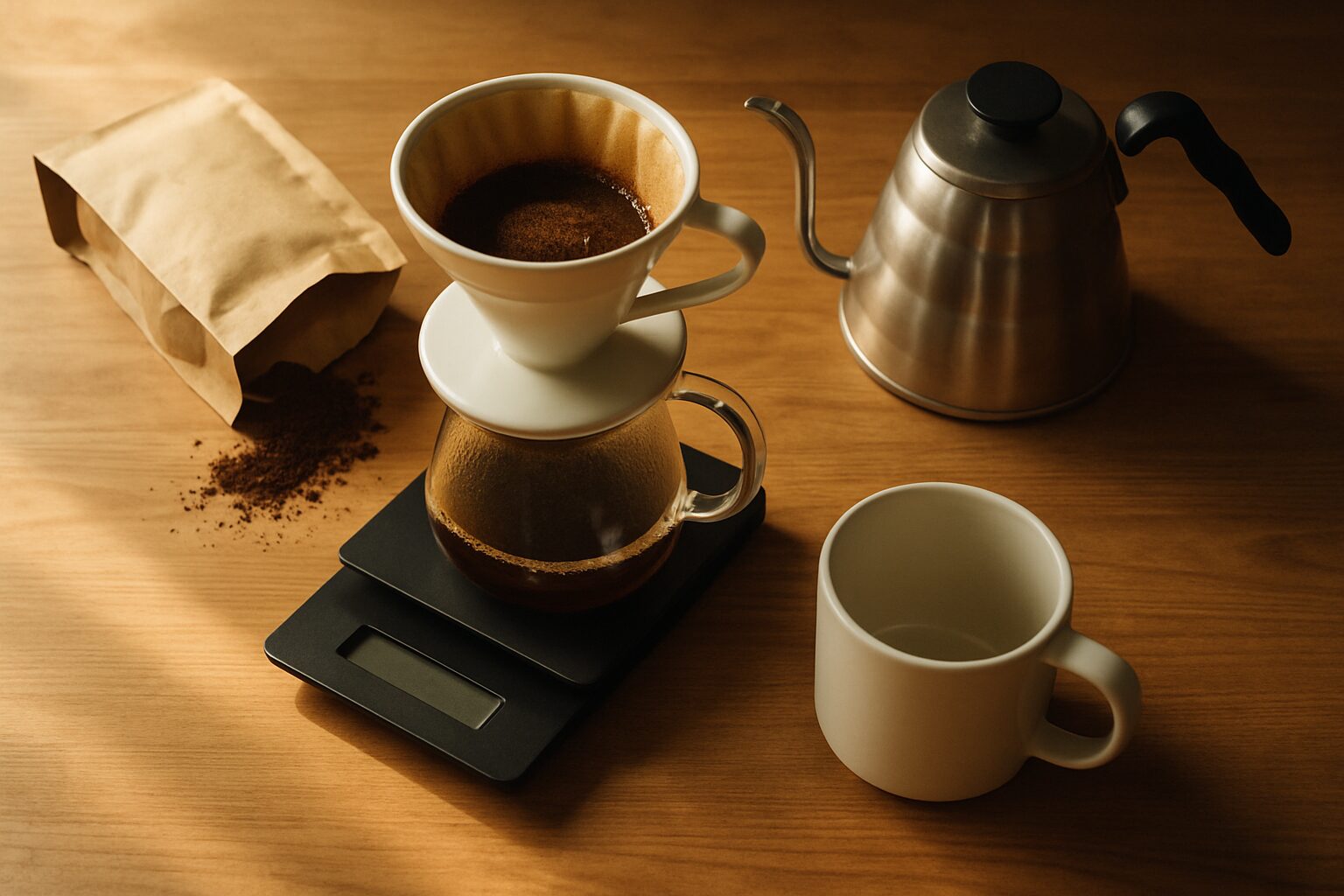
The forgiveness framework: what you can skip vs. what you can't
The V60 has a wide window on most of its variables and a narrow window on two of them. Knowing which is which is the whole game, and it's the section every other recipe leaves out.

From our coffee sommelier
Maryna's weekly picks
“I taste thousands of coffees a year — I’ll only send you the few worth brewing.”
Something went wrong — please try again.
Free · Weekly · Unsubscribe anytime
What you can drift on, the forgiving zone:
- Ratio. 1:16 is your daily anchor. Going to 1:15 makes the cup heavier and a touch sweeter. 1:17 makes it lighter and cleaner. Both are good cups. Crema.co's V60 guide puts the same numbers a slightly different way.
- Exact pour shape. The classic spiral, center-out, gives you the cleanest cup. Pouring straight into the middle gets you something perfectly drinkable. Pour mechanics matter less than people will tell you.
- Gooseneck kettle. Helpful, not required.
- Filter rinse. It washes the papery taste off the filter and preheats the dripper, which matters more with bleached filters and a cold ceramic V60. With an unbleached brown filter, you can skip it for a daily cup and not notice.
What you can't skip:
- Fresh coffee. Stale coffee won't bloom right. It won't extract right. Nothing in this recipe makes up for it. Within about a month of the roast date is the rule. The deeper take on what "fresh" means is its own piece — why fresh-roasted coffee tastes different.
- Water in the 200 to 205°F range. Boiling water poured immediately is hotter than that, which can pull bitter edges out of light roasts. Tepid water under-extracts everything and gives you a cup that tastes empty. The 30-second rest after the kettle finishes boiling splits the difference.
That's the whole framework. Everything else, you can fudge.
Step by step: the daily recipe
Eight steps. Read them once, then make a cup.
- Heat the water. Bring your kettle just to a boil and pull it off the heat. While the water settles, weigh out your coffee: 20 grams for a single 10 to 12oz mug. By the time you're ready to pour, the kettle will be in the 200 to 205°F window. Basic Barista on dialing in V60 by taste breaks this out by roast: aim toward 200 for darker roasts, 205 for lighter ones.
- Grind. Medium-fine. The traditional reference is granulated sugar or table salt, coarse enough to feel grainy between your fingers, fine enough to almost look like wet sand. If you don't own a grinder, ask the roaster for drip grind and use the bag within a week.
- Rinse the filter (or skip it). Fold the filter along the seam, drop it in the V60, set the V60 on your server, and pour hot water through to rinse out the paper taste and preheat the cone. With an unbleached filter on a weekday, you can skip this. With a bleached filter or a cold ceramic V60, it's worth doing.
- Add the coffee. Dump the grounds in and give the dripper a gentle shake to level the bed. A flat bed is how the water moves evenly through the puck instead of around it.
- Bloom. Start your timer and pour about twice your coffee weight in water (for 20g, that's roughly 40g) in a slow spiral. The grounds swell and bubble. Fresh coffee blooms vigorously, almost rising up to meet the kettle. Per Stumptown's V60 brew guide, the visible bubble is your freshness tell: if the bed barely puffs, the beans have been on the counter too long. Wait 30 to 45 seconds and breathe in the smell. This is where the coffee bloom does its real work, and it's the best part of the whole routine.
- Main pour. Pour the rest of your water, to 320g total, in two or three smaller pours. Start in the center, spiral outward, then back. Keep the water level just above the coffee bed, not flooded. Heart Coffee's V60 brew recipe is sharp on this: flood the cone and water finds a path around the grounds, and you get a thin cup. Each pour takes 10 to 20 seconds. Pause briefly between them.
- Wait for drawdown. Once you finish pouring, the cone keeps dripping for another 30 seconds to a minute. Total time from bloom to last drip should land in the 2:30 to 4:30 window, with 3:00 to 3:30 as the sweet spot.
- Drink it while it's hot. The cup shifts as it cools. The sweetness gets bigger, the acidity sharpens, the chocolate notes show up later than the citrus ones. Taste it at three temperatures and pay attention to which one you like best. That's the data you need.
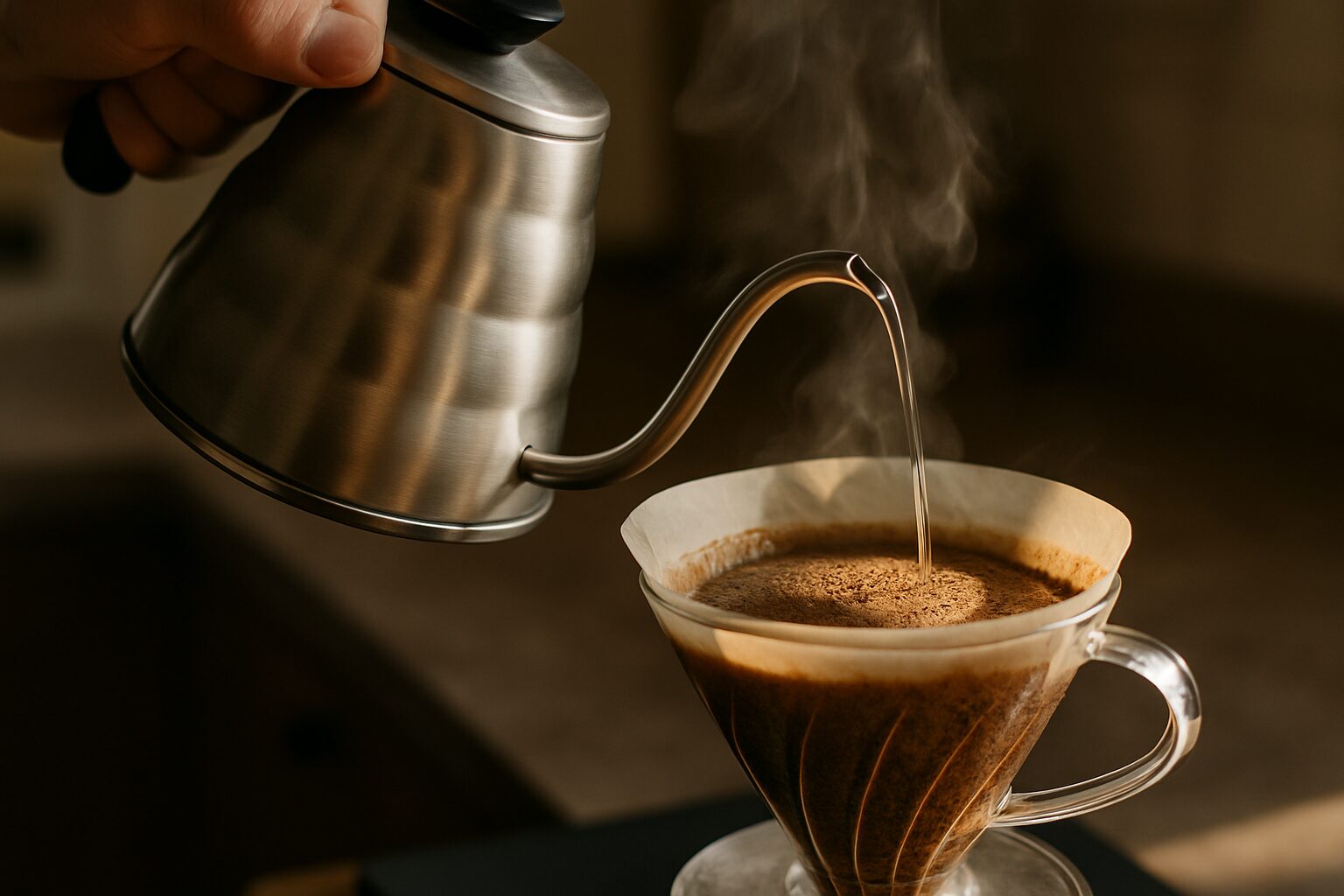
Troubleshooting: dial in by taste
If your first cup wasn't what you wanted, there's one rule. If the brew runs through fast and tastes thin or sour, grind a notch finer. If it stalls and tastes harsh or bitter, grind coarser. That's the whole instruction. Kaldi's Coffee's V60 deep dive is the simplest dial-in heuristic in the category, and it's all most home brewers need.
Taste before you adjust. As Basic Barista puts it, "tasting your coffee still remains the best way to dial in your coffee." Don't grind finer because the recipe said so. Grind finer because the cup told you to.
Two common screwups:
- Brew finished in 1:30 and tastes weak. Grind too coarse. Water raced through before it could dissolve anything but the bright top notes. Grind one notch finer.
- Brew stalled past 5:00 and tastes harsh. Either you ground too fine, or the puck channeled around a clump. Distribute the bed more carefully next time, and try one notch coarser.
I dial in by feel more than by stopwatch. On a clean light single origin, I taste the cup at three temperatures (hot, warm, almost room-temp) and pay attention to which flavors come forward as it cools. If the brightness is still loud at room temp, I went a notch too coarse. If the cup feels tired and dry by the second sip, I went too fine. The cup tells you. The full grind-size cheat sheet is its own piece if you want the per-method reference.
If you want the more precise version: the Hoffmann recipe
Most V60 recipes online riff on the same source: James Hoffmann's Ultimate V60. His version lands at 30g coffee, 500g water at 97°C (about 207°F), with a vigorous swirl during the bloom and a finish-stir at the end. The full method lives in his V60 Ambassador Q&A with Hario Europe, and it's worth a Saturday-morning attempt when you want to slow down.
His recipe isn't more correct than the daily above. It's more deliberate. For a Tuesday cup, the version I gave you gets you 90% of the way there with a quarter of the attention. For a weekend pour, his is the one to follow.
What to brew in your V60
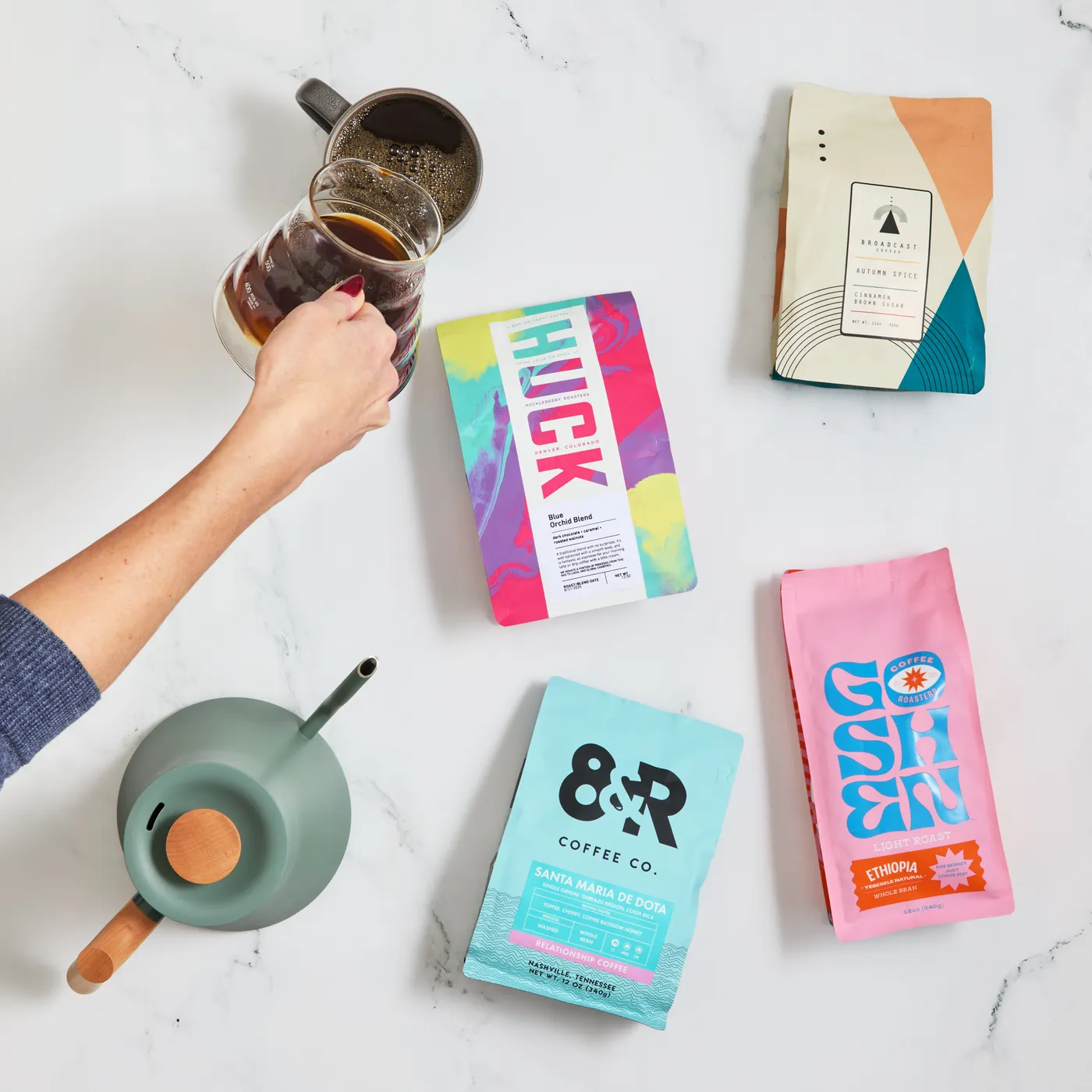
A forgiving recipe deserves forgiving coffee. The V60 brings out light and medium roasts best, clean and articulate and a little bright at the top. Dark roasts work, but you lose the way it pulls out delicate flavors. I'm partial to single origins for V60, Ethiopian and Colombian especially, where the bloom smells like dried fruit and the cup finishes on chocolate. The catalog data agrees. Across our light-roast coffees and single-origin coffees, the dominant tasting notes are chocolate, citrus, stone fruit, and caramel, the signature the V60 was built around.
If the freshness window worries you, that's what a coffee subscription you can build around your morning V60 is built for. Set the cadence to the pace you brew, pick the roast level you want, and freshly-ground coffees show up just before the last bag runs out.
The cup I'm chasing on a weekday morning is simpler than the gear pile suggests. The bloom rises and smells like wet bread and dried apricot. The first sip is bright and clean. The middle softens into chocolate or stone fruit. By room temperature, it's a different drink: sweeter, flatter, still good. That's the V60 doing what it was made to do. Three minutes, two ratios, one rule about freshness, and a quiet morning.
We want to help you make better coffee at home. Our recommendations are our own, and never sponsored. If you see something you love and buy it through our links, we may receive an affiliate commission (thanks for that!).
From our coffee sommelier
Maryna's weekly picks
“I taste thousands of coffees a year — I’ll only send you the few worth brewing.”
Something went wrong — please try again.
Free · Weekly · Unsubscribe anytime