What "Specialty Coffee" Actually Means (and Why It's More Than "Good Coffee")
 Maryna Gray
• September 08, 2026 — last updated September 10, 2026
Maryna Gray
• September 08, 2026 — last updated September 10, 2026
We've all picked up a bag stamped "specialty" and quietly wondered whether that word means anything, or whether it's just the coffee version of "artisan." Here's the good news: it does mean something, and once you can see it, the difference shows up right in your mug. A cleaner sweetness. Fruit and florals where commodity coffee hands you flat roast and bitterness. Let me walk you through what the word actually stands for, starting with the number everybody quotes, and the part where that number quietly stops telling the whole truth.
Because the term gets thrown around a lot, and most explainers pick a lane. They either fixate on a single score, or they pivot straight into a supply-chain sermon. I want to do both, honestly, including the slightly inconvenient bit where the people who invented the scoring system decided to move past treating it like a pass-fail gate. The 80-point number is real. It's just the start of the story, not the end.
The short version
We all want coffee that tastes like more than "brown and hot," and the shorthand for that is a specialty grade: an 80-or-higher score on a 100-point scale, awarded by trained tasters. But the number is really a stand-in for a chain of careful decisions, and I'll show you what each one buys you.
- Specialty means 80+ on the SCA's 100-point cupping scale, no more than 5 primary defects per 350g sample, judged by certified Q Graders. Estimates suggest only about 5 to 10 percent of the world's coffee clears the bar.
- But the score is a proxy, not gospel. The SCA itself replaced the single-number form with a holistic assessment in 2024, and a single point sits inside most cuppers' margin of error.
- The real story is the supply chain: altitude, hand-picking, careful processing, fresh roasting, and roasters paying well above commodity rates. That's what you're tasting, and what you're paying for.
What it actually means: the number, and who gives it
So let's start with the famous number. The widely accepted threshold is 80 points on a 100-point cupping scale set by the Specialty Coffee Association, the trade body that has long defined the standard. To clear it, a green coffee can have no more than 5 primary defects per 350g sample, and once roasted and brewed, it has to present in the cup free of faults. The scale tiers up from there: per the breakdown on Wikipedia's specialty coffee page, 80 to 84.99 is "Very Good," 85 to 89.99 is "Excellent," and 90 to 100 is "Outstanding." Hit 90 and you're in rare-air territory, the kind of coffee I'll happily clear my morning to sit with.
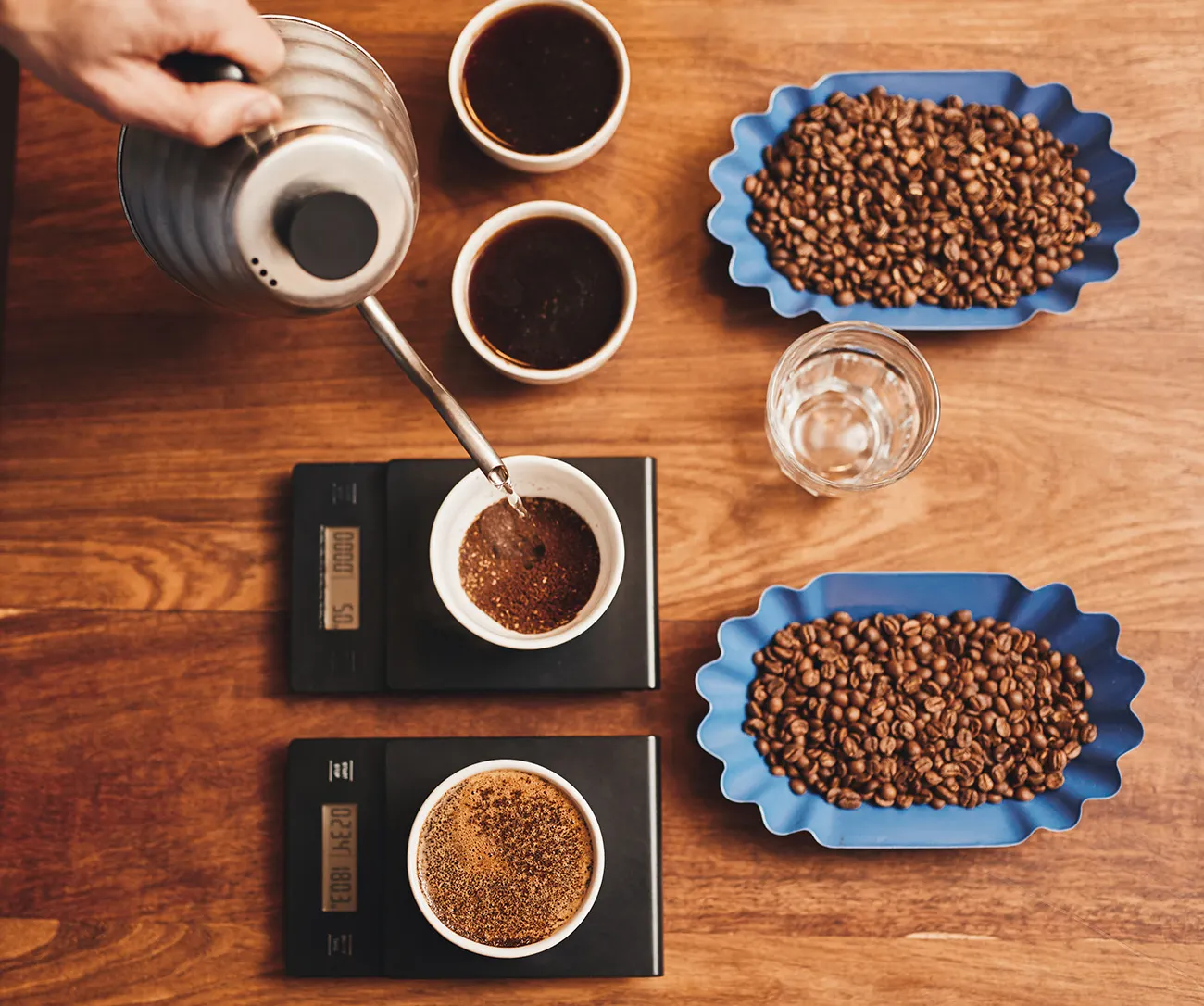
Who actually decides? Trained tasters called Q Graders. Becoming one is no small thing: a six-day intensive with roughly 15 sensory exams, the kind where you're matched against your own palate over and over until your scoring is reliable. The Coffee Quality Institute built the program, and the SCA took it over in 2025; more than 15,000 professionals have certified worldwide. When they cup a coffee, they score it across fragrance and aroma, flavor, acidity, body, sweetness, balance, and aftertaste. It's a structured tasting, not a vibe.

And the word itself has a human origin. A green-coffee broker named Erna Knutsen coined "specialty coffee" in 1974, in the Tea & Coffee Trade Journal, to describe beans of the best flavor produced in special micro-climates. The SCA's own tribute to Knutsen calls her the godmother of specialty coffee, and she helped found the association that still keeps the standard. Half a century later, her core idea holds: certain places, treated with care, make coffee that tastes like somewhere specific.
Why it matters: the number is a proxy, not the prize
Here's where I'll complicate the tidy story, because you deserve the honest version. That score is useful, but it's subjective, and the people closest to it say so. Royal Coffee has pointed out that scoring in 0.25-point increments makes pulling real statistical significance out of cuppers' scores nearly impossible. And Ian Fretheim, who runs sensory analysis at Café Imports, put it more bluntly in Perfect Daily Grind: "There is no such thing as an 83-point coffee that won't also score 84. One point is within the margin of error for most cuppers."
From our coffee sommelier
Maryna's weekly picks
“I taste thousands of coffees a year — I’ll only send you the few worth brewing.”
Something went wrong — please try again.
Free · Weekly · Unsubscribe anytime
The standard moved, too. In June 2024 the SCA retired the 20-year-old single-number cupping form and adopted the Coffee Value Assessment, which evaluates a coffee through four lenses (physical, descriptive, affective, and extrinsic) instead of one tidy number. Daily Coffee News covered the adoption when the standards were formalized later that year. The 80-point threshold survives as the popular shorthand, the thing everyone still says. But the official body deliberately walked away from treating it as a binary gate.
In practice, a lot of roasters have quietly raised their own bar. Many now treat 84 points as an unofficial floor, sourcing above the textbook minimum because that's where the coffees they're proud of tend to land. Which means "specialty" in the wild is often better than the rulebook requires. The honest takeaway to carry forward: the number gets you in the door, but what makes a coffee genuinely worth drinking is everything that happened long before the cupping table.
What actually makes it taste different
So what is everything-that-happened-before? It starts on a mountain. Specialty Arabica typically grows between 1,000 and 1,800 meters, and altitude does quiet, important work. Thinner air and cooler nights slow the cherry down as it ripens, and that slow development concentrates the sugars and acids that later read as fruit, florals, and that bright, layered complexity. Commodity coffee is often grown lower and faster for yield, which is exactly why so much of it tastes flat.
Then comes the picking, and this is where the labor lives. On a specialty farm, workers hand-pick only the ripe red cherries, passing over the same tree again and again across a harvest, instead of stripping every cherry off the branch at once. After that, the coffee gets a deliberate processing method (washed, natural, or honey) chosen to bring out the bean's character rather than to bury its flaws. (Is specialty just expensive coffee? No. It's intentional coffee, decision after decision, all the way down.)
Traceability is the next tell. With specialty you can usually name the farm, the region, the variety; the lot has a story you can follow, the opposite of an anonymous commodity bag blended from who-knows-where. That single-origin transparency is one of the clearest markers of the real thing, and it's a big part of why I gravitate toward single-origin coffees when I want a cup that tastes like a place rather than a recipe.

And then there's freshness, which is the variable most people underrate. Coffee hits its peak flavor roughly 5 to 14 days after roasting and starts fading after about 4 to 6 weeks, while a commodity bag on a grocery shelf can be months past its roast date before it ever reaches your cart. Buying close to the roast is a real part of why specialty tastes like specialty. (We go deeper on exactly that window in why fresh-roasted coffee tastes different.)
What it costs, and why the price is honest
Let's talk money, because "why does this bag cost more?" is the fair question lurking under all of this. There are four real drivers. The Arabica varieties specialty leans on yield less per plant than the hardier commodity stuff. The hand-picking is genuinely labor-intensive. Traceability carries its own overhead, all that record-keeping and relationship-tending. And the supply is small by definition, since only that estimated 5 to 10 percent of production qualifies. Scarcity, labor, and care all show up on the price tag.
There's a producer side to this too, and I want to be straight about it. Top specialty roasters often pay 2 to 4 times the commodity (C-market) rate to the farms they buy from. That matters, because across coffee broadly, growers can receive as little as around 10 percent of the final retail price. Specialty is the part of the industry trying to fix that imbalance, though not every supply chain wearing the label does it equally well. It's an aspiration the best roasters live up to, not a guarantee stamped on every bag.
So is 18 to 25 dollars a bag a rip-off? Honestly, no. For a labor-intensive, traceable, fresh-roasted product, that's roughly correctly priced. Our own catalog backs that up: the average live bag on Bean Box runs about $21.63, landing squarely inside that band rather than gouging above it. And specialty doesn't have to mean splurge, either; plenty of the genuinely good stuff sits at the accessible end, which is why we keep a whole shelf of coffees under $20 for the days you want quality without the ceremony.

How to use this
Good news: you don't need to memorize the SCA rubric to shop like you know it. Three real-world signals tell you you're holding the real thing. First, a visible roast date on the bag, because freshness is non-negotiable. Second, origin specificity: a named farm, region, or variety, not just "Colombian." Third, sourcing disclosure, where the roaster tells you something about what they paid or how they buy. See all three and you're almost certainly in specialty territory.
That's the pocket version. The full framework for not getting burned, how to read a bag and what the green flags and red flags are, lives in our guide to how to buy specialty coffee without getting burned, so I won't re-litigate it here.
Bottom line, and the bridge to where I'm headed: once you know what the word stands for, the smartest move is just to drink coffee from people who only deal in the good stuff. No detective work required.
So, is it worth it?
Here's what I keep coming back to. The 80-point number is real, but it's shorthand for a chain of careful choices — altitude, picking, processing, fresh roasting, fair pay. That chain is what "more than good coffee" actually means, and it's the through-line of everything above.
If you'd like a curated path through all of this without becoming a part-time Q Grader, that's the whole reason Bean Box exists. We work with dozens of independent roasters across the US: 657 live coffees from 61 partners as I write this, every one specialty by intent, several of them carrying competition awards. Tell us how you take your coffee and let us match you to it: build your Coffee Plan and we'll pick specialty coffee for you, tuned to your taste. Want to start at the deep end? Our award-winning coffees are specialty done seriously, the ones that earned their points the hard way. Brew one. Trust me.
We want to help you make better coffee at home. Our recommendations are our own, and never sponsored. If you see something you love and buy it through our links, we may receive an affiliate commission (thanks for that!).
From our coffee sommelier
Maryna's weekly picks
“I taste thousands of coffees a year — I’ll only send you the few worth brewing.”
Something went wrong — please try again.
Free · Weekly · Unsubscribe anytime